Wang brings blazing virtuosity as well as impressive conducting with Mahler Chamber Orchestra
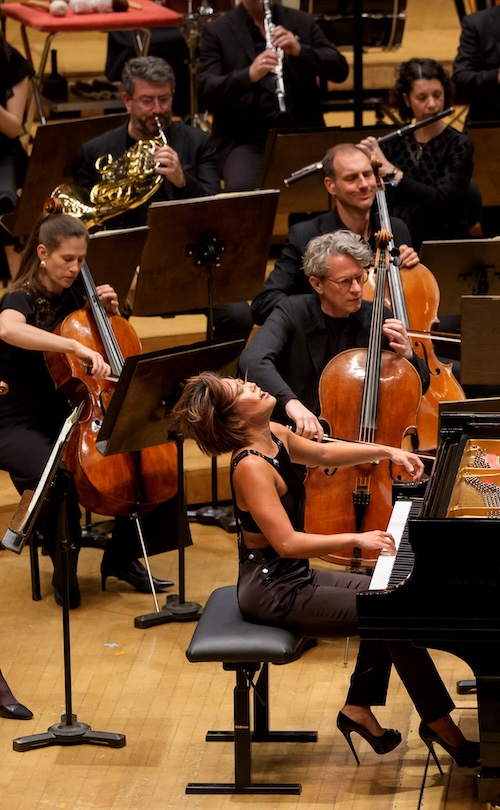
It’s been four long years for her many Chicago fans since Yuja Wang’s last local appearance. (She bowed out of Chicago Symphony Orchestra dates with Klaus Mäkelä in 2024.)
The popular pianist returned to town Wednesday night playing to a massive crowd of admirers—in a rare sold-out house at Orchestra Hall—as collaborator with the Mahler Chamber Orchestra, soloing in concertos by Chopin and Prokofiev.
Wang’s ten-city tour with the Berlin-based ensemble also served to spotlight the pianist in her newish role as pianist-conductor. She opened Carnegie Hall’s season last fall leading from the keyboard in Tchaikovsky’s Piano Concerto No. 1, and handled “play-directing” duties (as her program bio put it) in both of her concerto performances Wednesday night.
The concert opened with Prokofiev’s Symphony No. 1, the sole Yuja-less item of the evening. Concertmaster Matthew Truscott led from the first position, standing along with all of his violin colleagues. (They played seated for the rest of the program.)
As a calling card for the Mahler Chamber Orchestra, Prokofiev’s “Classical” symphony served its function. Founded in 1997 with the late Claudio Abbado a crucial mentor and early partner, the MCO attacked Prokofiev’s score with a game intensity and big, robust sound that belied their numbers.
While the players’ polished energy and commitment were notable, the Neoclassical wit and charm of the middle movements were largely missing in action, subsumed in this forceful and aggressive performance. Truscott and the players seemed to be aiming for a land-speed record in the finale, the lightning tempo nearly reducing the main theme to an undifferentiated blur. Even with that, the woodwinds managed to lend some welcome touches of personality to the hectic proceedings, but this was not a Prokofiev “Classical” to resonate long in the memory.
While pianists conducting Mozart concertos from the keyboard is nothing new, the fact that Wang was able to do so—largely convincingly—in two complex and challenging concertos showed that her taking up this new duo-role is not just some ego-driven fluke. She stood up from the bench to conduct in orchestral passages and guided them while seated with minimalist, sometimes generalized yet mostly effective gestures.
Chopin’s two piano concertos seem to have lost favor with soloists and orchestras over the past two decades, not entirely without reason. The composer’s orchestral writing is rudimentary and the solo writing centered on glittery filigree. In the Piano Concerto No. 1 in E minor (the second to be written but the first published), the long opening movement can be lumbering and interminable in some hands. Not for nothing did Chopin abandon the orchestra early in his career, realizing that his gifts lie in writing for solo piano.
Yet so engaging was Wang’s performance of the E-minor concerto that she made the best possible case for Chopin’s Op. 11. She brought out the limpid poetry especially well—as with the second theme of the opening movement—and kept Chopin’s brilliant solo writing in scale, throwing off the cascading roulades in typically faultless fashion without sacrificing an essential poise and refinement. The charm of the finale’s quirky main theme would have come off better at a less-rushed tempo but that’s the only possible cavil about her solo playing.
The MCO’s accompaniment in the Chopin was efficiently coordinated by Wang. At times, as in the central Romanza, one wanted a firmer grip and greater projection in the string playing, which appeared a bit diffident and softly focused.
If the Chopin concertos seem to be losing popularity, Prokofiev’s Piano Concerto No. 2 appears to be on the opposite trajectory. After being the least-often played of Prokofiev’s five keyboard concertos for most of its existence, the Second Concerto now seems to be coming into its own and gaining popularity with both soloists and audiences. (Seong-Jin Cho had a memorable outing with the CSO in the Second Concerto last season.)
Reconstructed after the original score was lost in a fire, Prokofiev’s Second Concerto remains a somewhat unsatisfactory work—launching with an introspective slow movement followed by three fast movements of increasing flash and mostly empty virtuosity. The Second is a showy but steely and unsentimental piece but perhaps its current popularity reflects that we live in a steely and unsentimental era.
Wang brought a searching yet cool expression to the opening Andantino, and was fully in synch with the composer’s brand of relentless spiky virtuosity. The pianist virtually somersaulted through the dizzying complexities and blizzard of notes in the succeeding movements with immaculate technical command—blazing through the madcap finale with complete accuracy at a velocity that one wouldn’t think humanly possible.
If the Chopin was very much a piano-led performance, Wang’s conducting proved genuinely impressive in the Prokofiev concerto, which was more of a real partnership. Clearly most of the work had been done in rehearsal but Wang still elicited admirable coordination in the rapid-fire back-and-forth, as well as vivid, hugely characterful playing from the chamber orchestra; the seismic tuttis and massive tread of the Intermezzo’s opening felt like the stomping of a malign giant.
Following the whirlwind virtuosity of the Prokofiev finale, Wang and company responded to the clamorous ovations with generous encores that converted Orchestra Hall into a kind of late-night jazz club.
The pianist essentially offered a third concerto in her encores, playing the four brief sections of Alexander Tsfasman’s Suite for Piano and Orchestra (or Jazz Suite) as individual encores. Tsfasman’s suite is written in a 20th-century “Soviet jazz” style, similar to Shostakovich’s works in that vein but cast in a more light-hearted fashion—think of a Slavic Leroy Anderson. Wang and colleagues were wholly in synch with the lightweight, effervescent style and brought out all of the suite’s considerable charms.
Wang and the Mahler Chamber Orchestra closed the evening with Márquez’s inescapable Danzón No. 2. Performed in a concertante arrangement by Leticia Gómez-Tangle, Marquez’s Greatest Hit morphed from a slinky Piazzolla-like tango to a slam-bang bravura finish.
Posted in Uncategorized
Leave a Comment
 Subscribe via RSS.