Valčuha, Chicago Symphony score with a sumptuous French feast
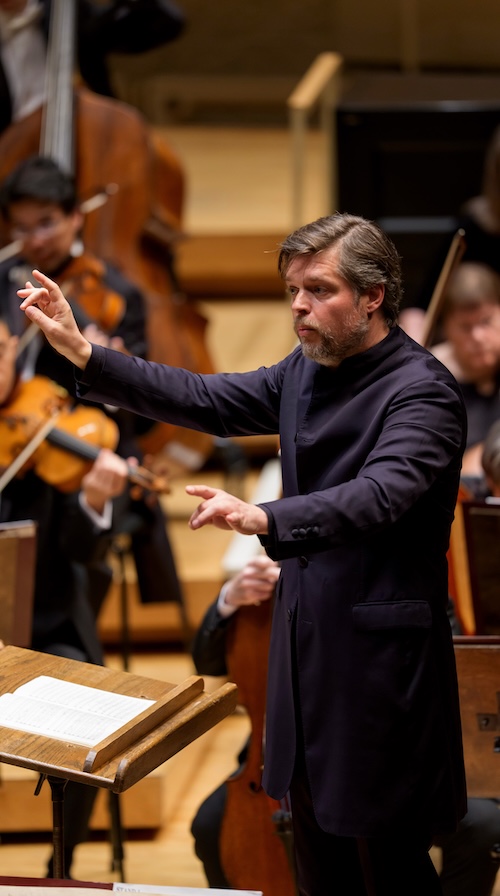
Timing may not be everything but it can count for a lot. As can the right programming.
When Juraj Valčuha made his Chicago Symphony Orchestra debut in 2017, the mixed impression was partly due to a lightish and unbalanced program. But that concert also came just two weeks after Jakub Hrůša’s sensational CSO debut, which made Valčuha’s own stand pale by comparison. The conductor received a more positive notice upon his return in 2024, but then, as on the previous occasion, the concert was dominated by the evening’s violin soloist, in that case Joshua Bell.
The third time proved the charm Thursday night, with Valčuha impressively leading a French program that was all gain over the Slovakian conductor’s previous CSO stands, with two repertorial cornerstones, contrasted with a choral intermezzo.
As often played as is Ma mère l’Oye, Ravel’s fairytale-inspired suite is one of those works that typically gets decent performances but rarely memorable ones.
That was not the case Thursday night. From the first notes, Valčuha drew a magical performance that was wholly beguiling, imbued with an elusive sense of childlike innocence and wonderment. Valčuha’s relaxed tempos and the orchestra’s refined playing created a hazy retrospective nostalgia in this Mother Goose that felt ideal. The iridescent Chinoiserie of Laideronnette was conveyed as surely as Beauty’s swaying waltz and the luminous resplendence of the Enchanted Garden. The playing of the entire orchestra could not be more glowing or communicative, not least the sensitively calibrated oboe and flute solos by William Welter and guest principal flute Aaron Goldman from the National Symphony Orchestra.
Francis Poulenc was devastated by the horrific death of a close friend in a car accident in 1936. That tragedy had a seismic impact on the composer’s life and art, ultimately leading to Poulenc returning to the devout Catholicism of his youth. Previously a purveyor of lightish, boulevardier works, Poulenc’s subsequent music was centered on a spiritual dimension with greater expressive depth, culminating in his masterpiece, the opera Dialogues of the Carmelites, as well as his Gloria heard Thursday night.
As ardent as was his belated return to the church, there remained a subversive side to Poulenc’s spirituality. He said of the Gloria, “While writing it I had in mind those Crozzoli frescoes with angels sticking out their tongues, and also some solemn-looking Benedictine monks that I saw playing football one day.”
That off-center element is manifest in Poulenc’s Gloria for soprano and chorus, a work that combines quirky cheerfulness with an informal spiritual sincerity.
Valčuha led a bracing yet flexible performance of the Gloria bringing out the playfulness as much as the more solemn qualities. The CSO Chorus, prepared by choral director Donald Palumbo, sang with daunting power in the opening and Qui sedes sections with clear antiphonal separation in the jaunty Laudamus te. Tuttis for the full chorus, however, verged on raucous and unyielding, with 110 singers sounding too massive for the music.
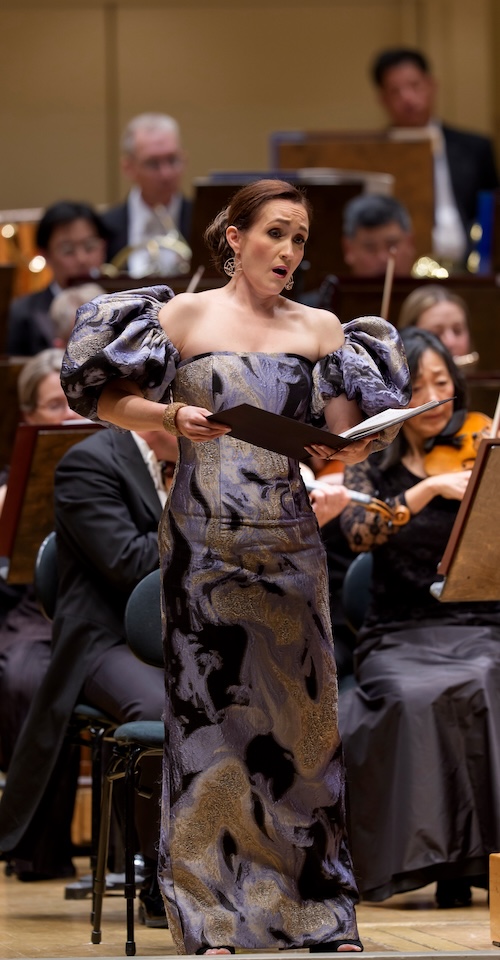
Thursday night. Photo: Todd Rosenberg
Erin Morley proved ideal casting as the soloist in this score. Often swaying to the music, the soprano’s singing of this perilous part was technically immaculate and—in a tough acoustic for high voices—always emerged bright, clear and gleaming. Morley’s purity of tone and expressive sincerity was most moving in her a cappella singing in the concluding Amen, rendered with natural expression and just the right gentle, benedictory glow.
If you want to introduce a friend to orchestral music, you could do worse than this CSO program, which concluded with Camille Saint-Saëns’ Symphony No. 3, a classical gateway drug par excellence.
Saint-Saëns’ “Organ Symphony” may be a semi-guilty pleasure. But it is also an extraordinarily rich and well-constructed work, masterfully scored with a painterly use of the obbligato organ (which doesn’t enter until the second movement), and one of the most thrilling finales in the orchestral literature.
Valčuha’s drawing of robust playing by the CSO on the first half indicated that this French showpiece would be firmly in his wheelhouse and so it proved. Yet the conductor also drew, refined and often surprisingly subtle playing by the CSO in a score often played for full-out power and sonic thrills. Valčuha uncovered scoring details rarely audible even in this often-heard work, and elicited transparent textures that allowed Saint-Saëns’ kaleidoscopic scoring to emerge with full impact—not least the climactic washes of two- and four-hand piano.
Valčuha ensured that the strings were refined and non-soupy in the hymn-like theme of the slow movement and maintained a stately pace through the relentless buildup of activity in the finale, before cutting loose with a burst of adrenaline in the closing bars. Organist Patrick Godon was a fine soloist, supplying the requisite glowing pedal points, sonic thunder and liquid lyricism as needed, always well integrated with the ensemble. The orchestra played at its considerable finest in this brilliant music bringing tonal richness and polished ensemble, while ramping up the intensity in the final pages.
Bring a newbie friend for the sonic spectacle of the Saint-Saëns, and you’ll also hear some wonderful singing in the Poulenc and world-class Ravel.
The program will be repeated 1:30 p.m. Friday and 7:30 p.m. Saturday. cso.org.
Posted in Performances
4 Responses to “Valčuha, Chicago Symphony score with a sumptuous French feast”
Leave a Comment

 Subscribe via RSS.
Posted May 16, 2026 at 6:28 am by Christopher Sheahen
A truly enjoyable performance.
Posted May 16, 2026 at 11:27 am by Roger
A very enjoyable and beautifully played matinee performance of French Pomp and Circumstance music.
Brits – step aside!
Posted May 16, 2026 at 11:13 pm by George Young
Exactly my take on the performance that I heard on Friday afternoon. Yes, the full chorus needed to rachet it down a step or two as what I heard was just too strident in many spots.
Posted May 18, 2026 at 1:04 pm by Louis Freedberg
Visiting from San Francisco, was pleased to hear the Chicago Symphony for the first time. As a chorus member myself in the Bay Area, I thought the chorus was marvelous, with the antiphonal or double chorus section especially superb. I hadn’t heard this work before, and was blown away by it.
Thanks to all!!