Cellist Herbert provides a summer highlight with Shostakovich
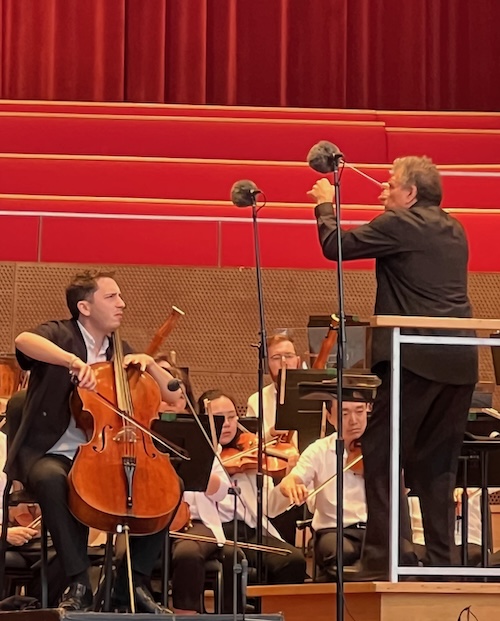
Meteorological fortune has favored the Grant Park Orchestra so far this summer. Wednesday’s torrential rains abated shortly before the curtain, much as they did on opening night, allowing a fine outing with a standout soloist to go forward without disruption under artistic director Giancarlo Guerrero.
Cellist Oliver Herbert was the solo protagonist in Shostakovich’s Cello Concerto No. 1, making his Grant Park debut. Herbert is a Curtis graduate who received an Avery Fischer Career Grant in 2021, and is making the rounds of increasingly prominent orchestras. His exceptional virtuoso playing Wednesday night made clear the reasons for his ascent.
The solo cello launches Shostakovich’s concerto in a severe vein, and Herbert sustained the Allegretto’s nervy tension without force or affectation. Acting principal horn Brett Hodge was a stern interlocutor, and Guerrero underlined the accompaniment’s many curiosities.
A desolate horn strain gives way to the cello’s lament in the Moderato, where Herbert eloquently captured the music’s essential ambiguity, maintaining an air of rumination to which Guerrero and the orchestra lent an ominous undercurrent. Herbert’s airy harmonics sighed effortlessly toward the movement’s end.
The cellist fully projected the neurotic solitude of the Cadenza, which Shostakovich sets apart as its own movement, with strummed left-hand pizzicatos giving the soliloquy a bardic feel. The closing Allegro con moto went with searing articulation, with Herbert in fulminating dialogue with the orchestra, coming together for the rousing, manic conclusion. The performance as a whole was a masterclass in pained, discordant music played beautifully.
As an encore, Herbert offered the famous Prelude to Bach’s Cello Suite No. 1 in G Major, played with purity and reflective equipoise, capping off an early highlight of the GPO season.
Guerrero led a genial account of Haydn’s Symphony No. 100 in G Major, “Military,” to close the night. The introductory Adagio opened sweetly before Guerrero plumbed its darker hues, and gently piping woodwinds adorned the untroubled Allegro.
The ensuing Allegretto is what lends the symphony its moniker, with its depiction of an approaching army, complete with Janissary percussion. Guerrero led the orchestra with Mozartean grace that he humorously built into military bombast, while remaining within the confines of good taste.
The orchestra was highly responsive to Guerrero’s inflections in the traipsing Menuet and the closing Presto went with cantering esprit, Guerrero hamming up a pregnant pause near the end with a knowing glance toward the audience.
The performance opened with Julia Perry’s Short Piece for Orchestra. Perry was the first African-American woman to have a work performed by the New York Philharmonic, and she was prolific despite a truncated career bedeviled by illness. The GPO first performed the Short Piece in their cautious post-COVID return in July 2021, and Wednesday’s performance made one grateful to have left the uncanny world of masks and distancing behind.
Guerrero led Perry’s enigmatic study with committed intelligence. After an agitated opening, the solo flute introduces a more questioning episode, with solo oboe and violin joining the queries. The work overall feels like an abstract investigation of gesture and sonority, with a pervading feel of uneasy quiet before a final lurching gesture, to which Guerrero and the GPO gave incisive advocacy.
Unfortunately, the leaflet-with-a-QR-code approach to programs appears here to stay at Grant Park, though it seems insulting to omit the orchestra roster from the printed handout, particularly while including three full pages of donors of various levels.
The Grant Park Orchestra performs Aaron Copland’s Symphony No. 3, Reena Esmail’s Black Iris and Prokofiev’s Piano Concerto No. 3 with pianist Stewart Goodyear 6:30 p.m. Friday and 7:30 p.m. Saturday. grantparkmusicfestival.com
Posted in Performances
Leave a Comment
 Subscribe via RSS.