Camerata Chicago opens with a premiere, Mendelssohn, and Maybe-Mozart
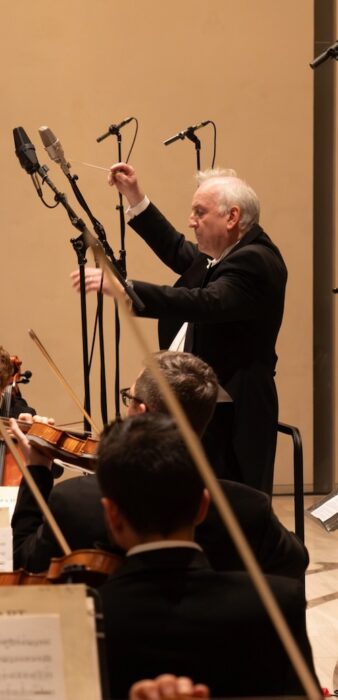
Camerata Chicago kicked off its 2026-27 season Friday night with a diverse program that tested the orchestra’s ability to play in radically different styles. Despite the l challenges of jumping from a world premiere to a quartet concerto to incidental music, conductor Drostan Hall demonstrated the ensemble’s versatility and led a high-quality performance at Fourth Presbyterian Church.
The orchestra began with the premiere of Fantasy on English Folk Tunes by Tony Payne, the ensemble’s composer-in-residence. Although the title of the work evokes an easygoing compilation of familiar melodies (à la works by Vaughan Williams, Holst and Grainger), Payne’s piece did not rely on audience familiarity with the source material, instead obscuring the folk tunes behind dense polyphony and frequent tempo changes. While some of those abrupt time changes lacked clarity, the piece left a strong impact thanks to its effective nding, a captivating violin-cello duet that led directly into a fugue, which was played with precision throughout the orchestra.
Following the premiere was the Sinfonia Concertante in E-Flat Majorfor wind quartet and orchestra, The work was attributed to Mozart in the concert program but is widely considered spurious — the piece as it exists today comes from an anonymous manuscript which was only discovered in 1869, almost a century after Mozart’s death.
It’s possible to convince oneself that Mozart wrote the piece but its little quirks — the strange half cadence concluding the second movement, the use of the same key for each movement, the clunkiness of the orchestral ritornelli in the finale — are plentiful enough to arouse suspicion in even a casual listener.
Questions of attribution aside, Camerata Chicago did justice to this strange work. Working in the boomy Buchanan Chapel with the piece’s heavy orchestration, Camerata Chicago achieved a tasteful orchestral balance that allowed each of the quartet members to shine in their fleeting solo moments. Even though the quartet members had subdued presentations, seldom looking up from their parts or moving to give cues as one might expect from chamber musicians, they played with remarkable unity and set a high standard of musicality that the orchestra lived up to.
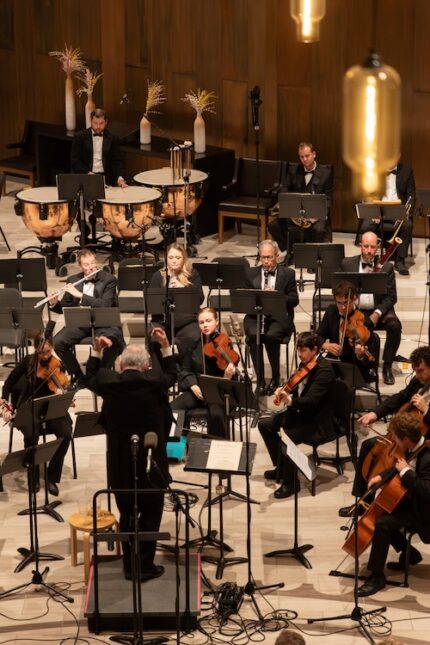
The second half of the program featured Felix Mendelssohn’s incidental music to A Midsummer Night’s Dream, performed in its entirety with narration by conductor Hall.
The performance started a bit sloppily in the famous Overture with unsynchronized entrances and intonation issues, but the orchestra came together strongly for the following movements. The flute section was fantastic in the Scherzo movement, and the horn-bassoon chorale of the Nocturne was magnificent — principal horn Lee Shirer deserves serious praise for his endurance and expressivity. The famous Wedding March concluding the work showed the orchestra at their strongest, triumphant but not overpowering.
While Camerata Chicago deserves credit for performing A Midsummer Night’s Dream as intended by Mendelssohn (rather than simply performing a few of the orchestral numbers in isolation), the narrative performance of the play proved difficult to follow. Hall brought tremendous energy to his line reading, but overextended himself by attempting to read the lines of every character. It was extremely difficult to parse the Shakespearean English and deduce when he was narrating a new character. This issue could have been circumvented by printing some or all of the Shakespeare’s text in the program or by using multiple narrators to cover each role. Both of those options would have come at some financial cost, but if the orchestra isn’t willing to take those measures, why bother performing the work in its entirety at all?
Despite the challenges posed by the programming and the venue, Camerata Chicago gave an impactful performance of poignant works. The minor and major flaws of the concert were overshadowed by the ensemble’s poise and ambition, a quality which bodes well for the orchestra’s future.
The program will be repeated 3 p.m. Saturday at Amerding Concert Hall in Wheaton and 3 p.m. Sunday at Union Church in Hinsdale. cameratachicago.org
Posted in Performances
Leave a Comment
 Subscribe via RSS.