Gesualdo Six’s remarkable artistry seamlessly spans the centuries
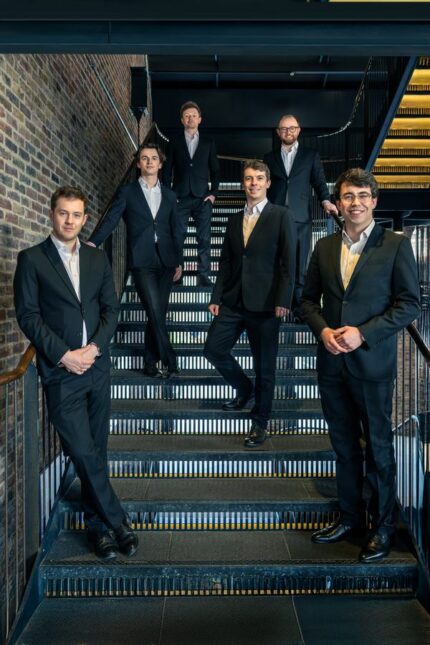
The Gesualdo Six made their Chicago debut in July 2025, performing “Secret Byrd” in a collaboration with Concert Theater Works, which recreated an underground Catholic Mass from late 16th-century England in the confines of West Town’s Salvage One.
Friday night the British vocal sextet performed at St. James Cathedral as the final stop on their current U.S. tour. The more traditional program and setting led their playful director Owain Park to consider it their “second debut” here. Founded in 2014 at Cambridge, the group has earned an international reputation for stunning performances of repertoire spanning centuries, and Friday’s performance surpassed even those high expectations.
The program, titled “Fading,” loosely revolved around Compline, the final daily prayer service in the Catholic liturgical tradition, with themes of reflection, ending, and protection running through the selections, which straddled the 16th and 20th-21st centuries.
The evening began with a triptych of 16th-century settings from Tallis, Sheppard, and Lobo. Tallis’ “Te lucis ante terminum” opened with the sanctuary in darkness, countertenor Alasdair Austin singing a pure-toned solo line from the transept, hauntingly answered by his colleagues from behind the audience.
In the Sheppard a quartet sang from the center of the cathedral as the ensemble gradually coalesced on the chancel, singing with a hypnotic blend as they proceeded up the aisles. There is “singing in tune” and then there is the sort of intonation that gives one chills, and the latter was on display in the limpid sighing of Lobo’s “Versa est in luctum” and throughout the night.
Two contemporary selections from British composers followed. Donna McKevitt’s 2020 “Lumen (Nunc Dimittis)” had a somber, inward expression, and Jonathan Seers’ “Look down, O Lord” set a text from Compline with an unsettled chromaticism.
The Six then leapt back several centuries with a set of von Bingen, Isaac, and one of the earliest Christian hymns, “Phos hilaron.” The latter was arranged by Park for solo countertenor Guy James with the other five voices as a collective drone, James filling the cathedral with his bell-like timbre. Isaac’s “Illumina faciem tuam” shone with luminous polyphony.
The first half closed with Josef Rheinberger’s “Abendlied,” written when the composer was in his teens. The six men sang the setting with an evocative inner glow of dusk that was spellbinding. Park commented on the “quality of the listening” at the performance, which was indeed silently rapt.
The second half opened back in modern-day England. Thomas Weelkes’ “When David heard” captured the anguish of Israel’s king upon learning of his son Absalom’s death. Joanna Marsh is a British composer who makes her home in Dubai, and her Arabesques sets four poems by Arab poets about women they have lost. “Fading” describes an aging bird losing her plumage, conveyed with a sense of brittleness and desiccation.
Another set from the 16th century followed with music Marenzio and Gesualdo offered with elevated grace. The Six swapped out Rimkus’ “My heart is like a singing bird” for Cheryl Frances-Hoad’s “The Promised Light of Life” from 2015, sensitively rendering the final English selection of the evening.
The program closed with two contemporary Canadian pieces. “O little rose, O dark rose” by Gerda Blok-Wilson blossomed like the flower of its title with a direct, folklike expression. Eleanor Daley sets a mystical text by Mi’kmaq poet Mary Louise Martin in “grandmother moon,” the six singers creating a nocturnal atmosphere in this closing number.
The Gesualdo Six brought the program full circle with a Tallis encore, “O nata lux,” ending the night with a final statement of glowing Renaissance polyphony.
The Gesualdo Six will return for another U.S. tour in February 2027. https://www.thegesualdosix.co.uk/
Posted in Performances
Leave a Comment

 Subscribe via RSS.