Two top tenors ignite Lyric’s “Cav & Pag” in a double bill to die for
An 11-inning final game of the World Series can be exciting, I grant you. But for those who instead chose to attend Lyric Opera Saturday night there were comparable vocal thrills aplenty with the company’s first “Cav & Pag” in 16 years.
There are several good reasons why Pietro Mascagni’s Cavalleria rusticana and Ruggiero Leoncavallo’s Pagliacci, remain the only regular double-bill in opera over a century since both works debuted. Both operas are lurid tales of adulterous love affairs in Italy that lead to murder; the short duration of each makes for a full and complementary opera evening; and both works virtually define the verismo genre.
Pietro Mascagni wrote 15 operas and one operetta over his long life. Sadly, none enjoyed anything close to the success of his first opera, Cavalleria rusticana. The reasons for the popularity of Mascagni’s 1890 one-act Cavalleria are manifest: a ceaseless flow of memorable melodies, masterful scoring, and a taut narrative that relates the tale of a violent love quadrangle in a concise 70 minutes.
The peasant Turiddu has jettisoned his former lover Santuzza for Lola, the wife of the carter Alfio. After a confrontation outside church on Easter morning in which Turiddu violently rejects the pleading Santuzza one final time, she swears vengeance and tells Alfio of the affair. Alfio challenges Turiddu who responds in the traditional way by embracing and biting Alfio’s ear. Alfio grimly replies “We understand each other” and awaits Turiddu offstage. A contrite Turiddu bids farewell to his mother, Mamma Lucia; soon a girl’s offstage cry that Turiddu has been murdered confirms his fate.
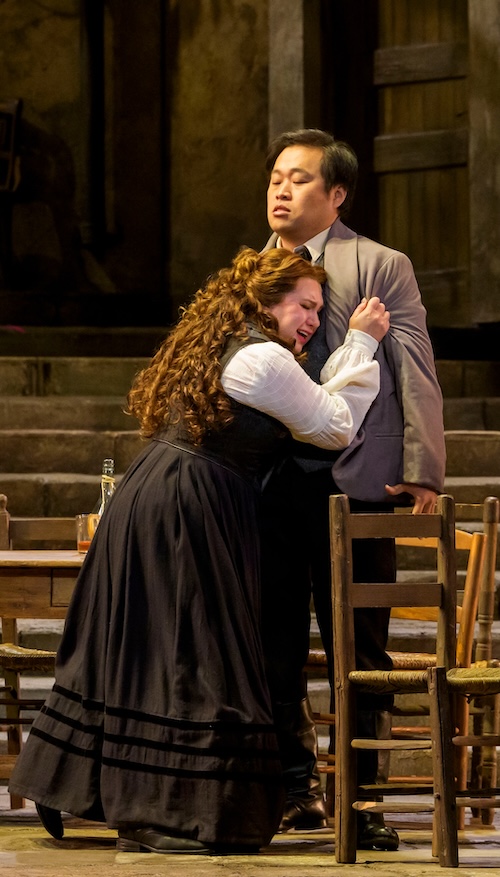
Lyric has revived Elijah Moshinsky’s traditional production for these performances. Michael Yeargan’s cramped yet atmospheric set evocatively paints a Sicilian village, though, oddly, without the church, which plays a central part in the narrative.
Lyric Opera has seen few house bows in recent years to match the sensational company debut by SeokJong Baek as Turiddu Saturday night. The young Korean tenor is the real thing, blessed with a big Italianate voice, ample squillo, intelligence and taste. From the yearning ardor of his offstage Siciliana that opens the opera, Baek was terrific across the board, impassioned in his confrontation with Santuzza, delivering a jaunty Brindisi, and conveying stark remorse and impending doom in his final aria. It was a genuine thrill to hear a voice of this quality cutting loose in Mascagni’s soaring music. The young singer also has dramatic chops, and Baek conveyed the persona of the impulsive, self-pitying Turiddu whose affair with another man’s wife leads to his sad fate.
As the rejected Santuzza, Yulia Matochkina was nearly as fine vocally. The Russian mezzo-soprano has an attractive, flexible and lustrous voice with enough reserves of power for this role. She sang an affecting “Voi lo sapete,” soared over the chorus’s Easter hymn (“Regina coeli”) and brought fervent desperation to her scene with Baek’s Turiddu.
Dramatically, Matochkina proved less inspired. The hectoring Santuzza is a tough role to carry off, but the mezzo’s melodramatic gestures and histrionics were over the top even for this emotionally unhinged character, for which revival director Peter McClintock must take some blame.
Quinn Kelsey is the only cast member to appear on both ends of Saturday’s double bill. With his suit and walking stick, Kelsey’s Alfio was more a bourgeois nouveau-riche owner of a successful trucking firm, than the usual T-shirt-clad ruffian who drives a horse cart.
Despite his mobster-like social promotion, Kelsey’s Alfio is clearly still someone you don’t want to mess with. Singing fluently with his dark, oakey tone, the baritone delivered a spirited account of his aria and conveyed the lurking violence beneath the character’s respectable exterior in his duet with Santuzza.
Lauren Decker was a big-voiced Mamma Lucia, the contralto recovering deftly after she accidentally knocked over a chair opening night. Ryan Center member Camille Robles was a serviceable Lola. The Lyric Opera Chorus sang with rich-toned splendor and radiance in their many ensembles, with an especially stirring Easter hymn, under chorus director Michael Black.
Director McClintock handled the tricky traffic flow in and out around Yeargan’s awkward, high-staired set smoothly and unobtrusively with a couple lapses. The key moment when Turiddu insults Alfio by throwing his wine to the ground was visually blocked by chorus members at the front of the stage. And having Santuzza stagger around the set in a dazed manner during the radiant Intermezzo was a dubious conceit.
Enrique Mazzola must have gotten the memo after his milquetoast conducting of Medea last month. The company’s music director sounded unleashed, directing an impassioned performance of Mascagni’s beautiful score, bringing out the roiling dramatic intensity as surely as the lyrical richness. Apart from one scary moment during Alfio’s aria when Kelsey and the orchestra went separate ways, coordination with the singers was generally secure opening night.
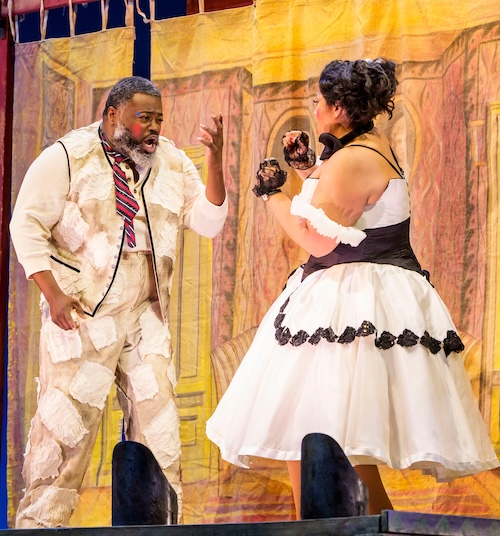
Leoncavallo’s Pagliacci, which followed after intermission, echoed the Mascagni performance to a large extent—-a showcase tenor turn, a female lead who proved stronger vocally than dramatically, superb orchestral playing, and a fluent staging with some missteps.
Russell Thomas’s performances at Lyric in recent seasons have been a mixed bag with vocally uneven outings in both Fidelio and Aida. On Saturday night as Canio—the cuckolded actor of a traveling theatrical troupe who is driven to homicidal madness by his faithless wife Nedda—Thomas delivered his finest Chicago performance in years.
The veteran tenor brought striking sweetness of tone to his ominous warning to a villager not to joke about his wife’s fidelity (“Un tal gioco, credetemi”) and Thomas rose to the challenge of “Vesti la giubba” with impressive power, secure top notes, and a genuine sense of Canio’s emotional devastation. In the climactic play within a play of Act II, he fully conveyed the character’s mounting fury as Canio repeatedly bursts out of his clown role to confront his wife.
Gabriella Reyes was better suited to Nedda, Canio’s sexpot wife, vocally than dramatically. She overdid the girlishness in the early going, seeming more like a caricature of Nedda rather than a complex, rounded character. Reyes handled the high tessitura of “Stridono lassù” with ease; yet the soprano’s superficial vocalism brought little poetry and inwardness to this intimate aria, failing to convey the sense of a desperate woman who seeks escape from her loveless marriage. Reyes handled the complex demands of Act II efficiently, if without the kind of quick reactions and acting skills the scene demands.
Quinn Kelsey’s great night continued as Tonio. The baritone delivered a virtual seminar with his magnificently sung and acted Prologo before the curtain, ideally setting the stage for the drama to follow. In the opera proper, Kelsey conveyed the affecting heartbreak of the disabled troupe member who loves Nedda but is treated with cruel contempt by her, leading him to take revenge by revealing her adultery to her husband. For some reason, director McClintock changed Tonio from a hunchback, as the libretto calls for, to merely having a handicapped leg. (“What hump?” as Marty Feldman said.)
Luke Sutliff made an impressive company debut as Nedda’s secret paramour Silvio, singing with a golden baritone in their love duet and (awkwardly blocked) lust scene. As Beppe, Ryan Center member Daniel Luis Espinal displayed a pleasing tenor voice and delivered a lilting account of Arlecchino’s Serenade (“O, Colombina”).
The chorus is as much of a primary character in Pagliacci as the principals, and Lyric Opera’s ensemble (and the young singers of Uniting Voices Chicago) vividly enacted their roles as participating audience members in Act II, reacting with unease, panic and eventual horror to the mounting violence onstage.
McClintock’s direction of that complex scene and most of the opera was resourceful and professional. Less inspired was the prominence given to the half-dozen clown stagehands of the troupe, whose ubiquitous presence in Act II—running around, throwing props back and forth, and overreacting to the proceedings—proved an annoying distraction, at times upstaging the climactic action of the principals. Sometimes less is more.
The minimalist production updates the period to post WWII Italy, largely unobtrusively. It was a nice touch to have Tonio speak the opera’s famous final line (“La commedia e finita!”) rather than Canio as has long been traditional. Such was Leoncavallo’s original intent and by Tonio doing so, it neatly frames the action and brings the opera full circle back to the Prologue.
As with the first half of the evening, Mazzola seemed like a different conductor then last month, leading a fiery performance of this intimate tragedy. At times there was as much drama and intensity coming from the Lyric Opera Orchestra in the pit as was happening onstage.
Cavalleria rusticana and Pagliacci run through November 23. lyricopera.org
Posted in Uncategorized
2 Responses to “Two top tenors ignite Lyric’s “Cav & Pag” in a double bill to die for”
Leave a Comment

 Subscribe via RSS.
Posted Nov 08, 2025 at 2:45 pm by Fiona
Agreed on all counts, with one exception. I did not attend the opening night but at the weekend performance Maestro Mazzola was back to his breakneck speed conducting, leaving several singers almost out of breath. Sometimes, even fiery has to be tempered.
Posted Nov 18, 2025 at 6:01 pm by Jeffrey Collord
Love the review! I was equally astonished by Baek and found Thomas to be in superb voice.