Newberry Consort misfires its musket with overstuffed, preachy “Revolution!” program
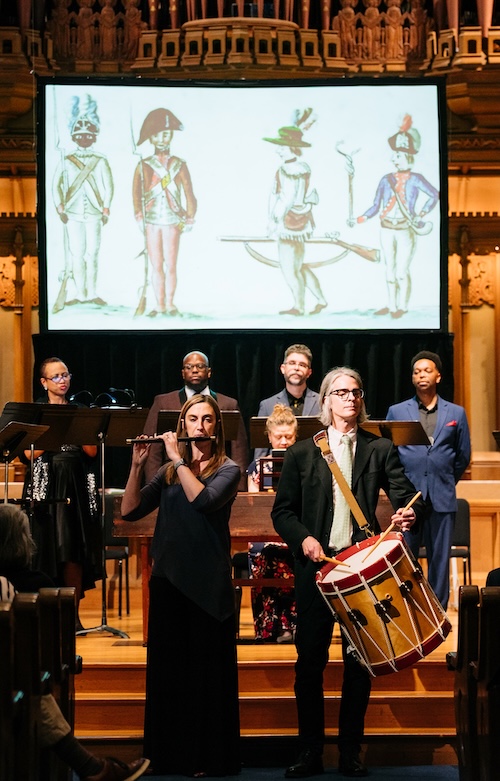
Under artistic director Liza Malamut, the Newberry Consort has been one of the most consistently imaginative and successful of programmers in Chicago. But on the rare occasions when one of their concepts misses the mark, it often does so in spectacular fashion.
Unfortunately, such was the case with “Revolution!”, the ensemble’s season-closing program, presented Friday night at First Unitarian Church of Hyde Park. There is one more local performance Sunday at Ganz Hall.
The Consort’s program is one of several on the local scene this month—with more to come before July 4—musically marking the nation’s 250th anniversary year.
In this case the Consort concentrated on music from the Declaration of Independence in 1776 to the start of the Civil War. The 14-member ensemble for this program was made up of four singers (countertenor Patrick Dailey, mezzo-soprano Kimberly Eileen Jones, tenor-countertenor Matthew Dean, and bass-baritone Jonathan Woody) and ten period instrumentalists (including trombonist Malamut), the latter sometimes joining in the singing as well.
Not to say there were not some worthy discoveries amid the dizzyingly copious selections from this near-century of musical Americana.
The most successful elements came with some fascinating early American curios. Benjamin Carr’s Rondo in E flat, engagingly performed by Sylvia Berry on a 1795 Broadwood square piano, began with a buoyant tune of rustic charm, followed by a surprising segue into the minor exploring darker currents. The ensuing “Rhode Island Jigg & Duport’s Hornpipe” by Pierre Landrin Duport provided a musical snapshot of colonial domestic music-making, played here by flute, violin and piano.
A vigorous instrumental Yankee Doodle march for fife and drum led into William Billings’ extraordinary “Lamentation for Boston.” Billings’ Biblical paraphrase memorializes the five American victims of the Boston Massacre who were shot dead by British troops, a contributing cause to the ensuing Revolution, and was sung movingly by the a cappella quartet.
While the concert was structured by theme and groupings like most Newberry programs, with eight titled sections of over two dozen mostly short works, there was more of a “bitty” feel to the evening than usual.
Paradoxically, the concert felt like too much and too little—trying so hard to cover a lot of ground that it wound up losing a unified overall perspective.
For an America 250 concert, there was little that was actually celebratory or even all that positive as we approach the nation’s semiquincentennial. As the evening unfolded, the primary motivation seemed to be some tortuous identity box checking, with such esoterica as a Moroccan Sephardic prayer, Mohican-Moravian hymn, and a grouping devoted to Choctaw hymns.
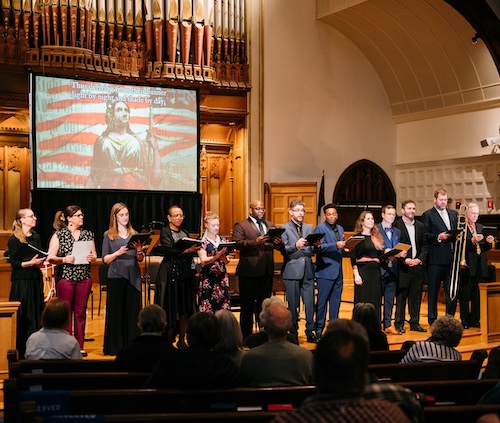
The biggest unforced error came with the penultimate work on the program, Jonathan Woody’s When Shall America, (oddly, grouped under the “Revolution!” title). The Consort’s first commission in its history, the work is being heard in its world premiere at these concerts.
The baritone-composer draws on writings of black American writers of the era (Phyllis Wheatley, Lemuel Haynes and Samuel Occur) as well as writing his own texts. The non-vocal first part of Woody’s work is intriguing with a John Williams-like stoic theme first announced by solo trumpet, then proceeding to other instruments and combinations in ear-catching variations.
Unfortunately, Woody’s ensuing parable is downbeat and incendiary, telling of a white slaveowner, “John,” who rapes a female slave and later whips her mercilessly bloody, possibly killing her. (The lack of available texts made some key details amorphous.)
Happy Fourth of July to you too. Closing the concert with this violent and repugnant scenario felt jarringly out of place, putting a dark and decidedly negative cast to the evening and a concert that was supposed to be, at least in part, a celebration of America.
In his program note Woody congratulates himself on his cynical view of the nation’s 250th anniversary (“I chose to share my version unflinchingly”). Well, everyone who is in favor of slavery raise your hand. The singer-composer also states that “In 2026, the United States seems further away from its ideals of liberty and justice than ever before.” The Americans who were actually wearing chains in the 18th and 19th centuries may beg to differ.
Woody’s piece was the biggest misfire but the concert also suffered from presentation issues, which are usually Newberry’s strength. The Consort is normally scrupulous in supplying texts and translations, but offered no texts for this program likely because all the words were in English.
So, despite solid diction by the excellent singers, in this high-ceiling Gothic space words were not always clear and discernible, especially in faster selections. One found oneself continually leaning forward and squinting to make out the light-colored song lyrics in Shawn Keener’s fuzzy projections.
Consequently, the essence of many of the vocal selections was lost or diluted, especially the political satire of “Address to the Ladies” “The Congress” and “Rogues All!” Though it is gratifying, as with the latter two odes, to know that politicians were viewed with disdain and loathing even in the Continental Congress era.
The program will be repeated 5 p.m. Saturday at Saint Joseph Chapel in Milwaukee, and 4 p.m. Sunday at Roosevelt University’s Ganz Hall. newberryconsort.org
Posted in Performances
2 Responses to “Newberry Consort misfires its musket with overstuffed, preachy “Revolution!” program”
Leave a Comment

 Subscribe via RSS.
Posted May 12, 2026 at 10:19 am by Sara Paretsky
We apparently experienced two very different concerts. I thought this was the most brilliant in the Newberry Consort’s season of outstanding music. Liza Malamut is an outstanding, inspiring historian of music. She put together many different musical perspectives and many different histories of the first 200 years of this country.
I came away deeply, viscerally moved, and wanted to hear the whole thing all over again from the beginning. A program that includes 350 year-old Choctaw hymns with music people created in their own homes is something you will never hear anywhere else. We also were privileged to hear the world premiere of Jonathan Woody’s “When Shall America.”
Posted Aug 05, 2026 at 8:03 am by Plush
The review is accurate and appreciated. Amid a genuine 250th Anniversary celebration, one would want to hear reinforcement of what makes America admirable and respected. That the director of the Newberry chose to offer this offal, and increasingly political stance to a concert audience is so off-putting. As is her constant insertion of trombone even in eras where the trombone did not exist.
Companies that offer “message music” lose audience much quicker than those who restrain themselves from “educating” the audience. I notice message music in too many companies’ offerings these days in Chicago.