Mäkelä wraps an auspicious autumn with thrilling Stravinsky and Walton
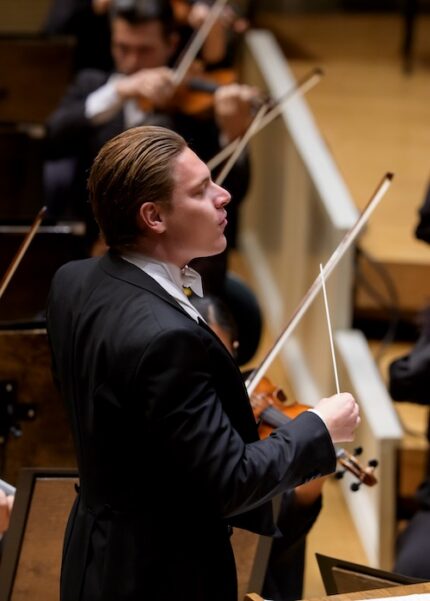
When Klaus Mäkelä made his Chicago Symphony Orchestra debut in 2022, the major work on the program was Igor Stravinsky’s complete Firebird ballet. Those impressive concerts served as a crucial calling card for the young conductor’s burgeoning relationship with the ensemble.
Since then, Mäkelä has led the CSO in riveting performances of The Rite of Spring and an even more probing and sumptuous Firebird at Ravinia this past August.
For the final program of his fall CSO residency, Mäkelä is completing his trilogy of the Stravinsky/Diaghilev ballets with Petrushka, heard Thursday night.
One thinks of the other two celebrated Stravinsky ballets as being more kaleidoscopic but Petrushka is as richly scored and just as much of a symphonic showpiece, especially in the full-tilt brilliance of the performance served up Thursday night.
One of Mäkelä’s great strengths as a conductor is his clarifying of complex scores—revealing textures and secondary instrumental lines in a way that is consistently piquant and illuminating without seeming pedantic or merely clinical.
So vivid and compelling was this boldly projected Petrushka that one could envision every element of the narrative as if the dancers were onstage—the dingy squalor of the Shrovetide fairgrounds, the puppet Petrushka’s alternating fury and impotence at his fate, the flirtatious Ballerina’s graceful waltz with the obtuse Moor and the unsettling finale.
This brassy, big-boned Petrushka may have leaned more into the Russian—even Russian-American—side than the ballet’s French elements. Yet so exhilarating were the results with the high-gloss virtuosity of the individual musicians and the CSO collective that one could hardly cavil.
There was standout work by principal trumpet Esteban Batallán whose gleaming solos and staggering bravura were outstanding even by his usual elevated standard. Equally impressive was the playing of guest principal flute Patrick Williams. Associate principal of the Philadelphia Orchestra, Williams played with a full, rich tone and graceful facility throughout, fitting in seamlessly with the CSO winds.
Both halves were preceded by brass music of Giovanni Gabrieli.
The evening led off with Gabrieli’s Canzon per sonar in echo duodecimo toni. With two groups of five musicians each (two trumpets and three trombones) standing near each other onstage Gabrieli’s antiphonal effects didn’t make quite as strong an impact as they likely did in Saint Mark’s Basilica.
Still the bright and gleaming performance—aided by the artful arrangement of principal trombone Timothy Higgins—brought clarity to the echoing phrases and contrapuntal writing, some fallible trumpet work apart. Gabrieli’s Sonata pian e forte (arranged by Eric Crees) fared better after intermission, providing a sonic palate cleanser between the two major works on the program.
Kudos to Mäkelä for bringing Belshazzar’s Feast back to Orchestra Hall following an unfathomable absence of a half-century since Georg Solti led the last CSO performances in the Bicentennial year.
Scored for huge forces, including extra brass bands, piano and organ, William Walton’s souped-up cantata is one of the most audacious and individual standalone choral works of the 20th century.
The mostly biblical text reflects the elaborate title repast of the tyrannical Babylonian king who has enslaved the Israelites, the famous handwriting on the wall telling of his fate, Belshazzar’s death, and the ultimate rejoicing of the freed slaves.
Walton’s work is more a brilliant showpiece for chorus and orchestra than a work of emotional depth or glowing spirituality. Still, with Thursday night’s performance coming three years and one day after the October 7 terror attacks in Israel, the lamentatory quality of the first half—and lines such as “They that carried us away captive” and “By the waters of Babylon, There we sat down [and] wept” —likely brought a painful contemporary resonance for many in the audience.
Here too Mäkelä led a thundering, bravura performance, leaning into the jazzy syncopations, and putting across the sonic spectacle with notable transparency and acute balancing without neglecting the more interior and subtler passages of Walton’s roiling score. (There actually are some.)
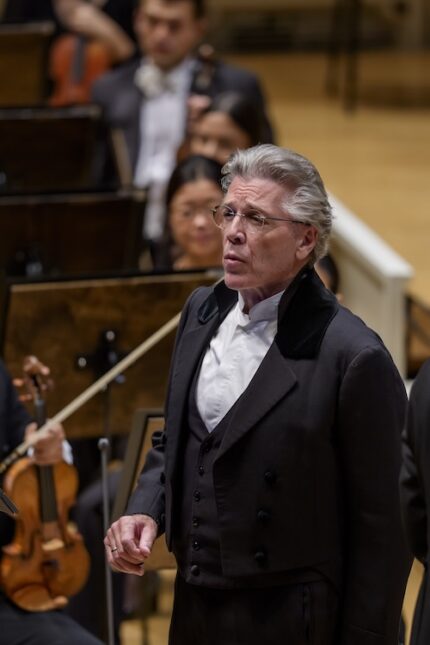
Thomas Hampson is well placed these days for the role of Walton’s cantor-like soloist, whose a cappella declamations introduce each of the three sections. The great American baritone is 71 and nearing the end of an illustrious career. Yet while his instrument may not be as tonally rich and rounded as in his prime, that natural aging element served to enhance Hampson’s strong and committed performance, the occasional tonal edge accenting the patriarchal authority of his solos.
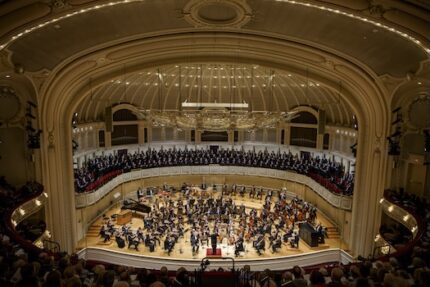
The Chicago Symphony Chorus—125 strong—sang with resounding power, amplitude and vocal clarity under the preparation of chorus director Donald Palumbo. So too the CSO musicians gave their incoming music director all he asked for in volume, intensity and whipcrack virtuosity, with the extra brass players in the terrace adding to the frenzied, nearly deranged jubilation of the final bars.
Klaus Mäkelä’s bond with the CSO musicians and popularity with Chicago audiences appears to be growing exponentially with each performance, as indicated by the increasing warmth of applause at his entrances.
For many, it will be a long seven months before Mäkelä returns in May. But the consistent excellence and brilliant music-making of these past three weeks in highly demanding repertoire bodes very well indeed for this musical partnership as the charismatic Finnish conductor gets closer to taking the CSO reins in the fall of 2027.
The program will be repeated 7:30 p.m. Friday and 6:30 p.m. Saturday (minus the Gabrieli) as the Symphony Ball concert. chicagosymphony.org
Posted in Performances
7 Responses to “Mäkelä wraps an auspicious autumn with thrilling Stravinsky and Walton”
Leave a Comment
 Subscribe via RSS.
Posted Oct 09, 2026 at 2:44 pm by CHARLES CAPWELL
Just about the most stunning Petrushka imaginable, and I heard Monteux. What a fine conductor this boy (OK, young man) is! He makes this great orchestra sound newly refurbished.
Posted Oct 09, 2026 at 3:08 pm by Peter T. Borich
Spectacular . . .Consistent clarity, precision, and excitement not experienced by this concertgoer since Sir Georg . .Wow
Posted Oct 09, 2026 at 3:49 pm by lynne lasser
I didn’t love the tone of the baritone in the Walton and couldn’t make out a single pitch he sang but agree his presence and delivery met the moment. The chorus was really the star of that piece–they’ve been great under Palumbo.
Petrushka was terrific, I agree, exceptionally good balance among the winds in the quieter moments and Williams managed the difficult flute work with elan.
Posted Oct 09, 2026 at 6:39 pm by Ben Auwaerter
Belshezzar’s Feast sent shivers through my limbs multiple times in its final 2-3 minutes. The piece speaks for itself, of course, but the virtuosity of the CSO’s assembly was as good as I could’ve asked for. 10/10 – no qualms!
Posted Oct 10, 2026 at 6:48 am by Ed Lindquist
What an amazing evening. Makela has brought such vitality and freshness to the CSO. Subscription seats are usually in the mezzanine, but we were moved to the orchestra area, half way back, center.
What a blessing for this evening. 5 minute standing ovation with tears in my eyes. Bravo CSO.
Posted Oct 10, 2026 at 9:11 am by Ray Osborn
As a Brit, it seems unconscionable that Belshazzar’s Feast hasn’t been performed by the CSO for fifty years. That’s why this is my first live performance even though I’ve listened to recordings for decades. It made me realize how conventional much of the programming has been under Barenboim and Muti. We have never had a Rattle to shake things up–perhaps finally we do.
I don’t think Belshazzar’s Feast is as unsubtle as the review suggests even if it’s clearly a young man’s work. The final exultation is earned by the preceding lamentations and is one of the most exhilarating endings in all music. I agree that Mäkelä was magnificent in both pieces.
Posted Oct 11, 2026 at 7:40 am by bruce nelson
The Apollo Chorus performed Belshazzar’s Feast under the baton of Thomas Hoekstra in 1989. I know since I was in the chorus and it is a very difficult piece to sing. GPMF performed it in 2018. Hopefully CSO will not wait another 50 years before doing it again.