Haymarket’s inspired cast and crew serve up a stunning “Orfeo”
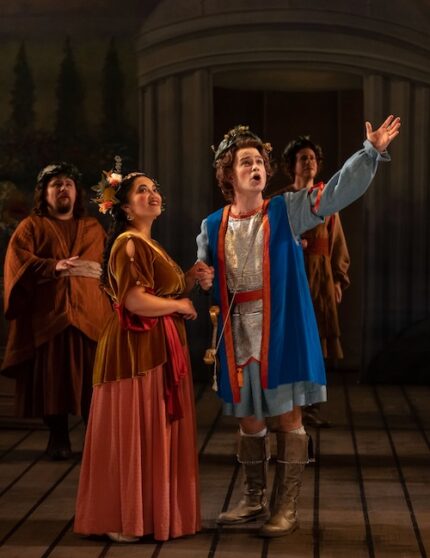
The Haymarket Opera Company under music director Craig Trompeter has burgeoned over the years into one of the city’s true musical gems, lately moving from triumph to triumph.
In their second collaboration with the venerable Newberry Consort, Haymarket offered Claudio Monteverdi’s landmark L’Orfeo Friday night at DePaul’s Sasha and Eugene Jarvis Opera Hall in Lincoln Park. The performance was unimpeachable, with glorious musicianship and stagecraft bringing Monteverdi’s 1607 score to life.
Tenor Zachary Wilder, making his Haymarket debut, did not put a foot wrong in the title role. Singing with fluent, effortless expression, Wilder confidently conveyed Orpheus’ emotional shifts from joy to grief and resolve to doubt. His halting efforts to make sense of the news of Eurydice’s death and imploring negotiations with Charon were memorably affecting, as was his rueful lament after losing his beloved.
Soprano Kimberly McCord, as Music, launched the evening with an alluring invocation of her art’s expressive powers, and mezzo-soprano Emily Fons as the Messenger was viscerally stricken delivering the news of Eurydice’s death. Fons’s supple mezzo deftly pivoted from the first act’s celebratory atmosphere to one of bewilderment and loss, capturing the character’s desolation as she contemplated her self-imposed exile.
Alexis Peart as Hope opened the Underworld sequences with her dusky mezzo, furiously declaiming the Dantean admonishment “Abandon all Hope, ye who enter.” Jonathan Woody’s sonorous bass-baritone made a forbidding Charon, singing over the accompanying regal (a small organ with bellows) and sackbut consort, which added to the subterranean ambience. The beguiling strumming of harpist Claire Happel-Ashe beautifully depicted Orpheus on his lyre pleading with the boatman.
As Persephone, soprano Hannah De Priest interceded with shimmering tone on Orpheus’ behalf. As her husband Pluto, bass-baritone David Govertsen sang with apt gravitas, even if the Lord of the Underworld seems too easily swayed in Monteverdi’s treatment. Baritone Evan Bravos sang Apollo with poise and paternal benevolence as he rescued his son to celestial immorality at the opera’s close.
Eurydice is a cardboard cutout in Monteverdi’s score, with two brief phrases and no subjectivity of her own, but soprano Emily Mwila (also a Haymarket debut) admirably lofted her few solo turns.
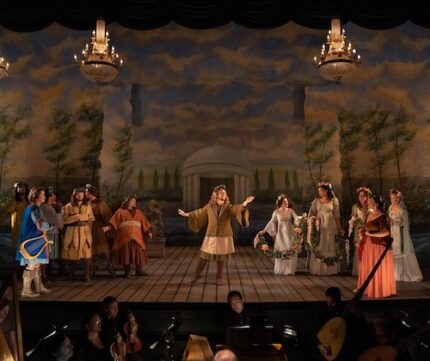
With the exception of Wilder (Orpheus), Mwila (Eurydice), and Govertsen (Pluto), all the singers joined other Haymarket mainstays in the chorus of nymphs and shepherds, in which tenors Patrick Kilbride and Michael St. Peter delivered a number of luminous solo and duo moments throughout the night. The men of this group also made a menacing chorus of internal demons in the Underworld scenes, their ominous delivery of the line “Orpheus conquered Hell but then was conquered by his own desire” encapsulating the evening’s drama.
Haymarket music director Craig Trompeter led the nimble Haymarket Orchestra from the pit with unfussy yet deeply committed leadership. Newberry music director Liza Malamut helmed the burnished sackbut consort.
Stage director Chase Hopkins deserves immense credit for the singers’ acting, which set this production apart. While the scenario may be familiar, soloists across the board portrayed their characters’ emotional states without becoming overwrought or drifting into bathos. Wilder’s Orpheus in particular had a complexity beyond what one often encounters in this role.
Set designer Wendy Waszut-Barrett’s beautifully painted and historically informed sets vividly framed the festivities in Thrace and the Underworld drama. The transition between Acts IV and V was jaw-dropping, as the pastoral Thrace paintings fell in such a way as to transform the Underworld’s River Styx into Thrace’s serenely bucolic stream.
Costume and lighting design by Stephanie Cluggish and Kelly Martin, respectively, were similarly historically informed in Haymarket and Newberry’s trademark anti-revisionist vein. The costumes were inspired by surviving sketches for a 1589 Florentine musical spectacle La pellegrina, and the soft, diffused lighting convincingly ingeniously channeled a candlelit stage.
Sarah Edgar’s choreography lent a Terpsichorean joie-de-vivre to the outdoor celebrations. Wigs and makeup by Megan Pirtle created distinctive aesthetics for the characters of the Thrace and the Underworld. The rigorous scholarship of dramaturg Louise K. Stein suffused all aspects of the production.
The only complaint one can make about Haymarket Opera these days is the difficulty of getting a ticket. Perhaps they need to schedule more performances?
L’Orfeo has two more sold-out performances 2 p.m. Saturday and Sunday at the Jarvis Opera Hall. haymarketopera.org
Posted in Performances
Leave a Comment


 Subscribe via RSS.