Performances
Conlon’s CSO Mozart cycle comes full circle with an outstanding “Abduction”
The Abduction from the Seraglio has led a prodigal life on […]
Bell, Grant Park Chorus shine brightly amid the lingering purple haze
Neither heat nor humidity nor thick plumes of smoke spurred by […]
Conductor debuts in mixed program with Grant Park Orchestra
In 2008, conductor Jeri Lynne Johnson founded Philadelphia’s Black Pearl Chamber […]
Articles
Hrůša, Bamberg Symphony give supreme advocacy to Martinů
Martinů: Symphonies Nos. 1-6. Jakub Hrůša / Bamberg Symphony (Deutsche Grammophon, […]
Concert review
Violinist, Grant Park Orchestra shine underground in a mostly American program
The Harris Theater is in every sense the opposite of the grand and imposing Pritzker Pavilion in Millennium Park. It’s a perfectly fine venue acoustically that makes a great stage for chamber and wintertime concerts, but it’s just not the same as the summer main stage.
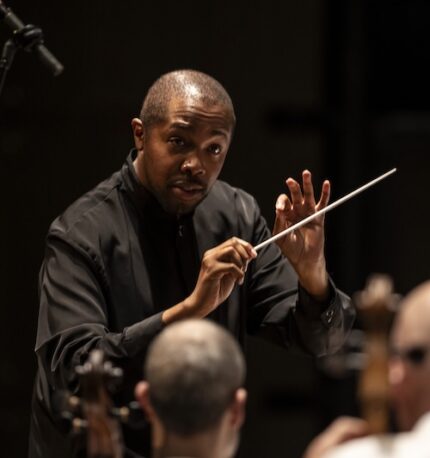
Nevertheless, the Grant Park Orchestra played to the hall’s strengths on Friday evening, escaping Lollapalooza with a varied and lighthearted program, led in uneven fashion by conductor Kedrick Armstrong.
Coleridge-Taylor Perkinson’s Sinfonietta No. 1 made for a more energetic opening to the concert than its strings-only instrumentation might suggest. The fast ostinato pulse and reluctance to establish a tonal center, evoked the symphonic works of Hindemith or Shostakovich.
But unlike some works by those composers, the Sinfonietta never felt too academic or theoretical due to its simple textures. After the first movement’s powerful D-major cadence, the second movement established a more tense mood with its brooding bass and distant violins. The third movement ratcheted up the intensity and dissonance to a level even higher than the first movement, though the final movement’s abrupt conclusion proved underwhelming under Armstrong’s direction.
There is a sort of irony to Coleridge-Taylor Perkinson being named after Samuel Coleridge-Taylor, one of the first black composers to achieve broad acclaim in his own time. The English-born Coleridge-Taylor was saddled with the moniker of the “African Mahler,” a backhanded compliment from his white peers that made his place in the racial hierarchy clear.
Gabriela Lara was the soloist in Samuel Coleridge-Taylor’s Violin Concerto. A former Grant Park Project Inclusion fellow, the Venezuela-born violinist was the first Chicago Symphony Orchestra member appointed by Klaus Mäkelä.
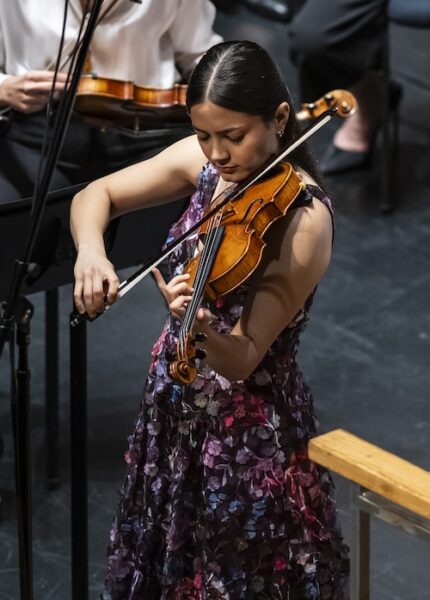
Lara proved a fantastic solo presence in both bombastic passages and less flashy moments of dialogue with the orchestra. The first movement began with an ominous, Brahmsian orchestral before the solo violin enters, beginning an exchange of aria- and recitative-like passages. The concerto exemplifies the formalism of a European work but intersperses elements of Coleridge-Taylor’s diverse influences: Punctuating the standard sequential modulation were bluesy dominant seventh chords and pentatonic motifs. Lara’s level of musicianship seemed to motivate the orchestra to give their most convincing performance of the evening.
Duke Ellington’s The Three Black Kings followed intermission. A product of Ellington’s final days, and completed by Luther Henderson, the work is written in three movements, the first two after Biblical kings (Balthazar and Solomon) and the final inspired by Martin Luther King, Jr.
Like Ellington’s late studio work (i.e. The Afro-Eurasian Eclipse), The Three Black Kings embraces a multicultural aesthetic—the delightful conga-driven, bossa nova second movement is a notable standout moment.
Unfortunately, the piece falters is in its finale, a dull and overlong pop-ballad-sounding segment that fails to convey any of the nuance or tragedy of Dr. King’s life. Still, for all its flaws, The Three Black Kings is still impressive for its showcase of Ellington’s longevity, a prolific and distinguished life in music that began in the big band genre.
Concluding the program’s exploration of American and American-adjacent music, was George Gershwin’s An American in Paris. Every subsequent hearing of this brilliant tone poem seems to lead to more rewarding discoveries, whether a subtle catchy melody in the orchestral texture or a sneaky transformation of one of the iconic themes. The implementation of taxi horns stood out especially in this live performance.
Armstrong led the Grant Park Orchestra with nonchalance, to varying levels of success. At its best, his laid-back approach invited the orchestra to take charge, such as with the loud entrances that came after punctuated silence, and in the concerto as a whole.
But Armstrong’s noninterventionist approach often made for occasional slack moments: in An American in Paris Armstrong had his head in the score and used the same mirrored gestures he had used for basically the entire concert, making for a scary tempo decrescendo in a slow passage.
Jack Moeser is a freelance writer and musician based in Chicago. He has degrees in music from Northwestern University and the University of Michigan, studying French horn performance with Adam Unsworth and Gail Williams. During his undergraduate studies, Moeser wrote for and edited the arts section of The Michigan Daily.
Posted in Performances
No Comments
Calendar
August 5
Grant Park Orchestra
Giancarlo Guerrero, conductor
Garrick Ohlsson, pianist […]
News
CSO announces two new musicians
The Chicago Symphony Orchestra has two new members. Youngji Kim […]
 Subscribe via RSS.