Violinist makes fiery Grant Park debut in Schwantner’s dramatic concerto
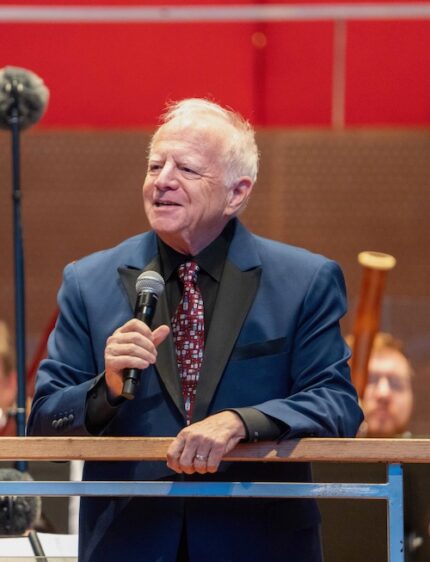
It has been old home week in July for former principal conductors of the Grant Park Music Festival. This past week has seen two programs helmed by Carlos Kalmar, and Friday night’s concert brought the welcome return of Leonard Slatkin to the summer concert series.
Slatkin led the lakefront festival for just two seasons (1974-75) but has been a semi-regular Grant Park podium visitor over the five decades since. (Slatkin’s last Chicago Symphony Orchestra appearance was in 2014.) This fall, the conductor becomes music director of the Nashville Symphony Orchestra (following the tenure of Giancarlo Guerrero, Grant Park’s current artistic director and principal conductor).
Slatkin’s program Friday night offered a pair of large-scale works reflecting two of his repertorial specialities, Russian and American music. The latter was reflected with the Chicago premiere of Joseph Schwantner’s Violin Concerto, which opened the evening, with Yevgeny Kutik as soloist.
After a prolonged period of non-plenty, there has been a bumper crop of first-class concertos by American composers in recent years, including Mason Bates’ Piano Concerto and Stacy Garrop’s Invictus, which was premiered in Chicago just last fall. One can add Schwantner’s Violin Concerto to that growing list.
Slatkin commissioned the concerto from Schwantner, a longtime friend and collaborator, during his tenure as music director of the Detroit Symphony Orchestra (2008-2018), where it was premiered in 2021. Due in part to the work being launched during the chaotic Covid era, the piece seems to have gotten lost in the shuffle. Yet Schwanter’s Violin Concerto is one of the Chicago-born composer’s finest efforts to date.
The Violin Concerto is cast in two large movements spanning 30 minutes. The first movement (“pensieroso e oscura”) begins with the orchestra in brooding darkness with low strings and intermittent piano and chimes in a kind of slow-treading ascent, which almost seems to echo Rachmaninoff’s The Isle of the Dead. The solo violin enters with a dramatic statement amid the harmonic tension and continues in a similar manner, the violin line going ever higher as if searching for a way out of the abyss. The tempo accelerates and the solo writing becomes increasingly agitated, faster and more virtuosic. Eventually the music slows and the brooding music returns, as the first movement ends quietly—the coda, unfortunately, undermined by a noisy, low-flying helicopter with impeccably bad timing Friday night.
The second movement (“Movendo”) begins with a quasi-cadenza by the violin soloist, accompanied by the orchestra, which segues into music of dramatic turbulence that dominates the movement with increasingly frantic and bravura solo bursts from the violin. Just as one begins to tire of the relentless hard-driving solo violin angst, a lyrical respite surfaces with a lovely, plaintive melody played by the violin soloist and a solo cello in a heartfelt duet. Stormy swelling chords lead back to the prevailing sturm und drang and increasingly fast and brilliant writing for the soloist. Eventually the ascending motif returns and the struggle reaches a climax, closing in a final solo burst and emphatic coda.
Schwantner’s Violin Concerto is a compelling and rewarding addition to the concert repertory—traditional in its solo versus orchestra conflict yet individual in its harmonic working out and characteristic of the composer in its craft, transparency and orchestral color (albeit a darker palette than usual). Perhaps there’s a bit too much nerve-wracked virtuosity yet one can still see this strong, brooding concerto joining Schwantner’s Percussion Concerto as a regular concert-hall visitor.
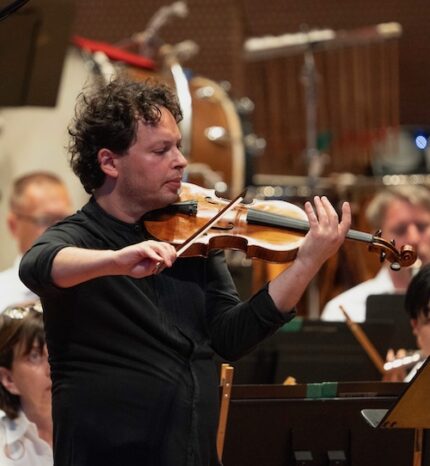
Yevgeny Kutik gave the world premiere of Schwantner’s concerto with Slatkin five years ago and the violinist served up a star-making performance Friday night—playing with big, febrile tone (as amplified), fire and blistering virtuosity in the nearly nonstop solo part. Slatkin’s boldly projected yet deftly balanced account of the equally demanding orchestral component was on the same high level.
Slatkin has been an inspired conductor of Russian repertoire throughout his career and one looked forward to Tchaikovsky‘s not unfamiliar Symphony No. 5 after intermission.
Unfortunately, whoever at the Grant Park festival made the decision to move the curtain time to 8:15 p.m.—to avoid conflict with the Taste of Chicago’s live music to the south—didn’t seem to take into account that the Taste’s fireworks display starts at 9:15 (as was clearly stated on the city website). The fireworks drowned out part of the Sibelius Second Symphony on Wednesday night and totally obliterated the first movement of Tchaikovsky’s Fifth on Friday, with the thunderous assault largely burying the Grant Park Orchestra.
Ironically, if the festival had kept to its usual 6:30 p.m. curtain—instead of moving the start time to nearly two hours later with a 20-minute intermission—the competing events would have likely proved less disturbing than the deafening fireworks enfillade. Better yet, the Grant Park Music Festival should have moved all of this week’s concerts indoors to the Harris Theater and avoided any potential of competing sonic distractions altogether.
The festival is currently between CEOs, with the incoming Anwar Nasir not yet on the job, and the lack of a firm and savvy hand on the tiller was evident in this week’s embarrassing logistical debacle. In the real world—i.e., outside of government and the arts—this is the kind of epic failure that people get fired for.
Slatkin and the GPO musicians were troupers, however, soldiering on with unruffled professionalism throughout the long first movement despite the deafening sonic booms and bangs. “Someone needs to tell them that this is not the Tchaikovsky piece with the fireworks,” the conductor joked at the end of the movement.
Fortunately, the rest of the symphony was undisturbed and one could enjoy this superb Tchaikovsky rendering sans distractions. The post of GPO first horn remains vacant, and Patrick Walle, principal du jour, lifted a polished if rather square solo in the Andante, with Slatkin eliciting rich string tone in the lyrical ebb and flow. The ensuing waltz movement was lilting and elegantly turned.
At 81, the conductor remains a vigorous presence on the podium and Slatkin drew an authentically Russian, deep-pile sonority from the ensemble throughout, which paid particular dividends in the surging final movement. Slatkin’s acute balancing and attentive dynamic and tempo marking were consistently manifest with broader tempos than usual at times yet still ample excitement in the buildup to the triumphant final section. The Grant Park Orchestra brass section delivered their finest outing of the summer to date, rich of tone and playing with crackling virtuosity.
The program will be repeated 8:15 p.m. Saturday. gpmf.org
Posted in Performances
Leave a Comment
 Subscribe via RSS.